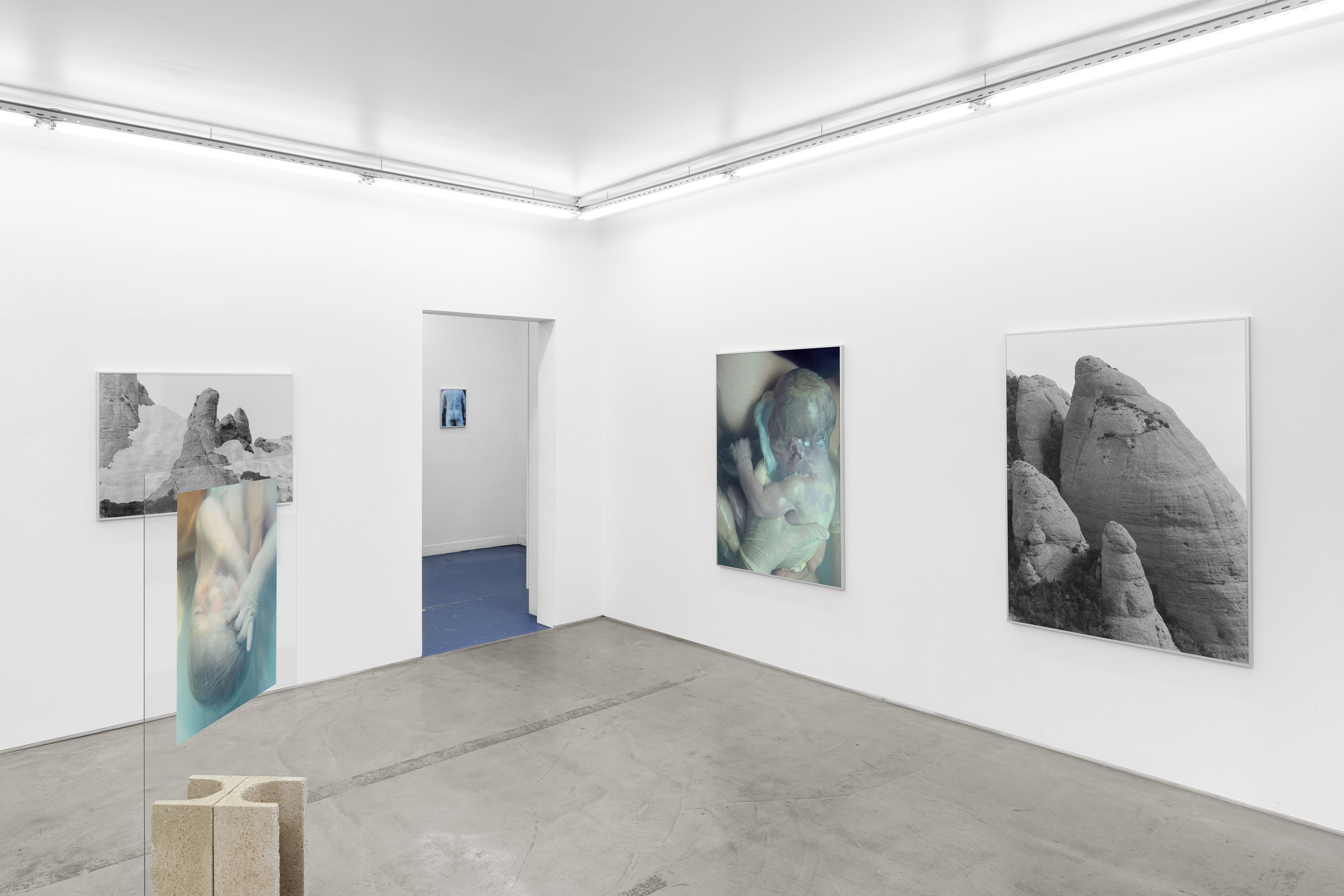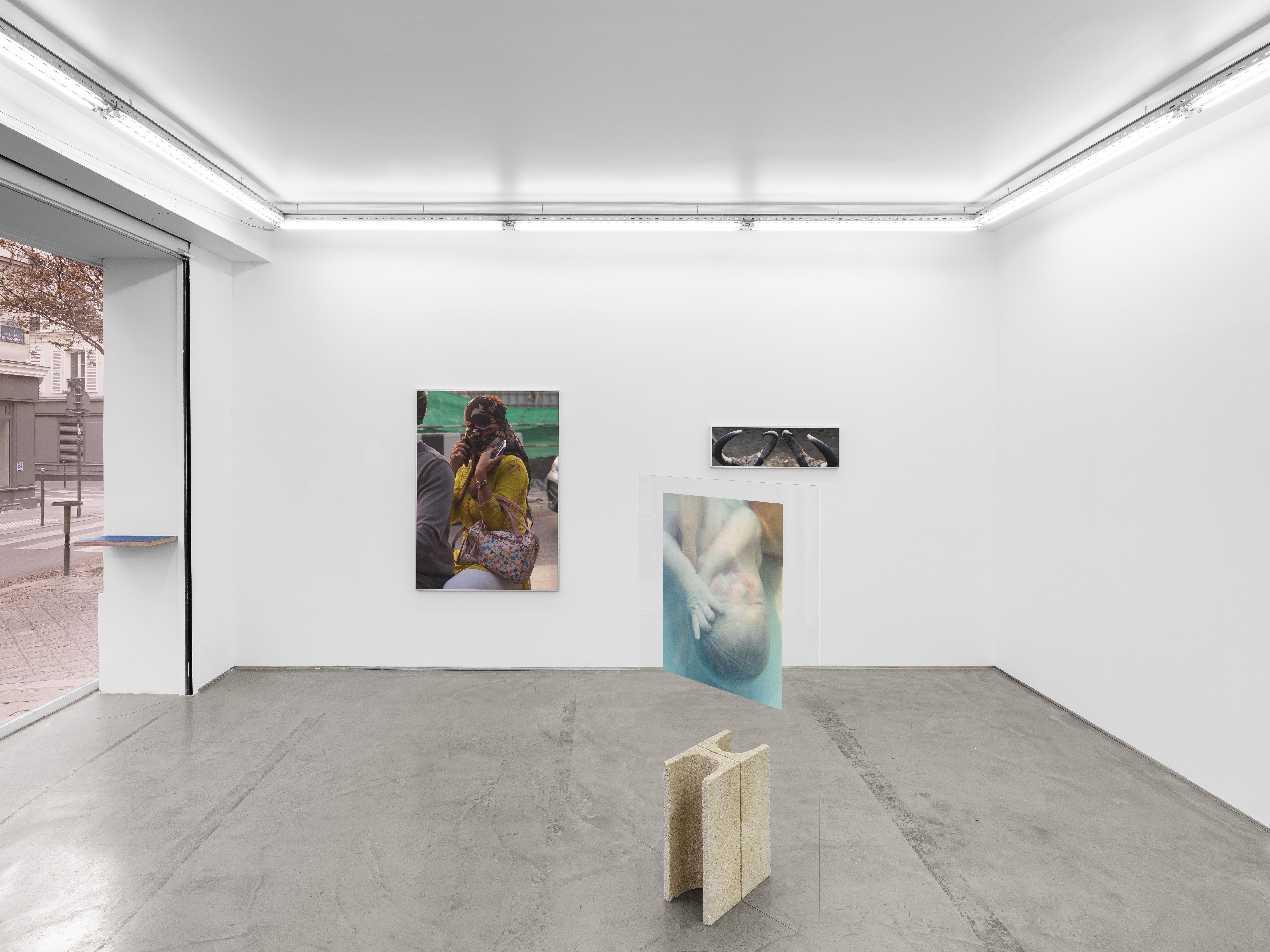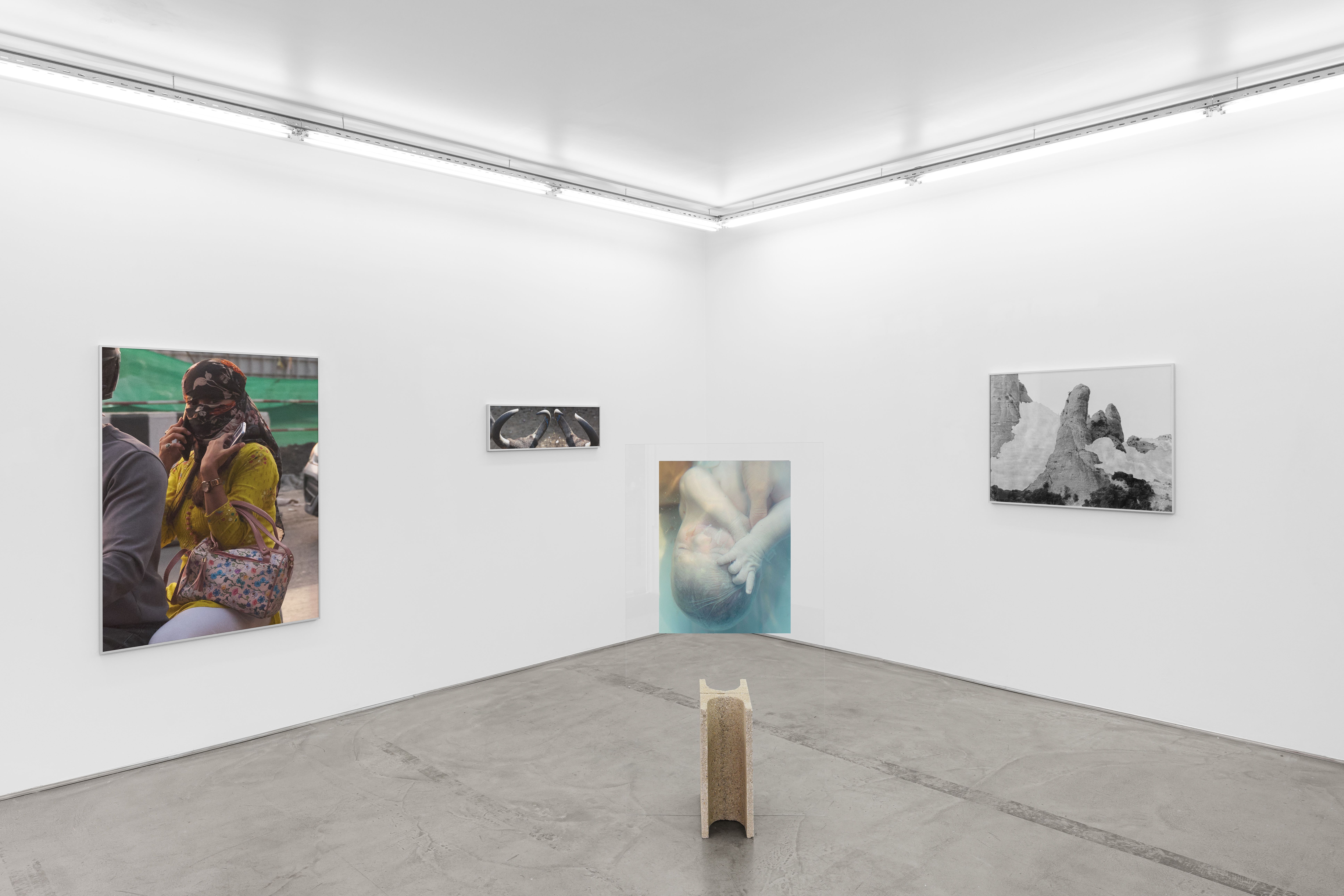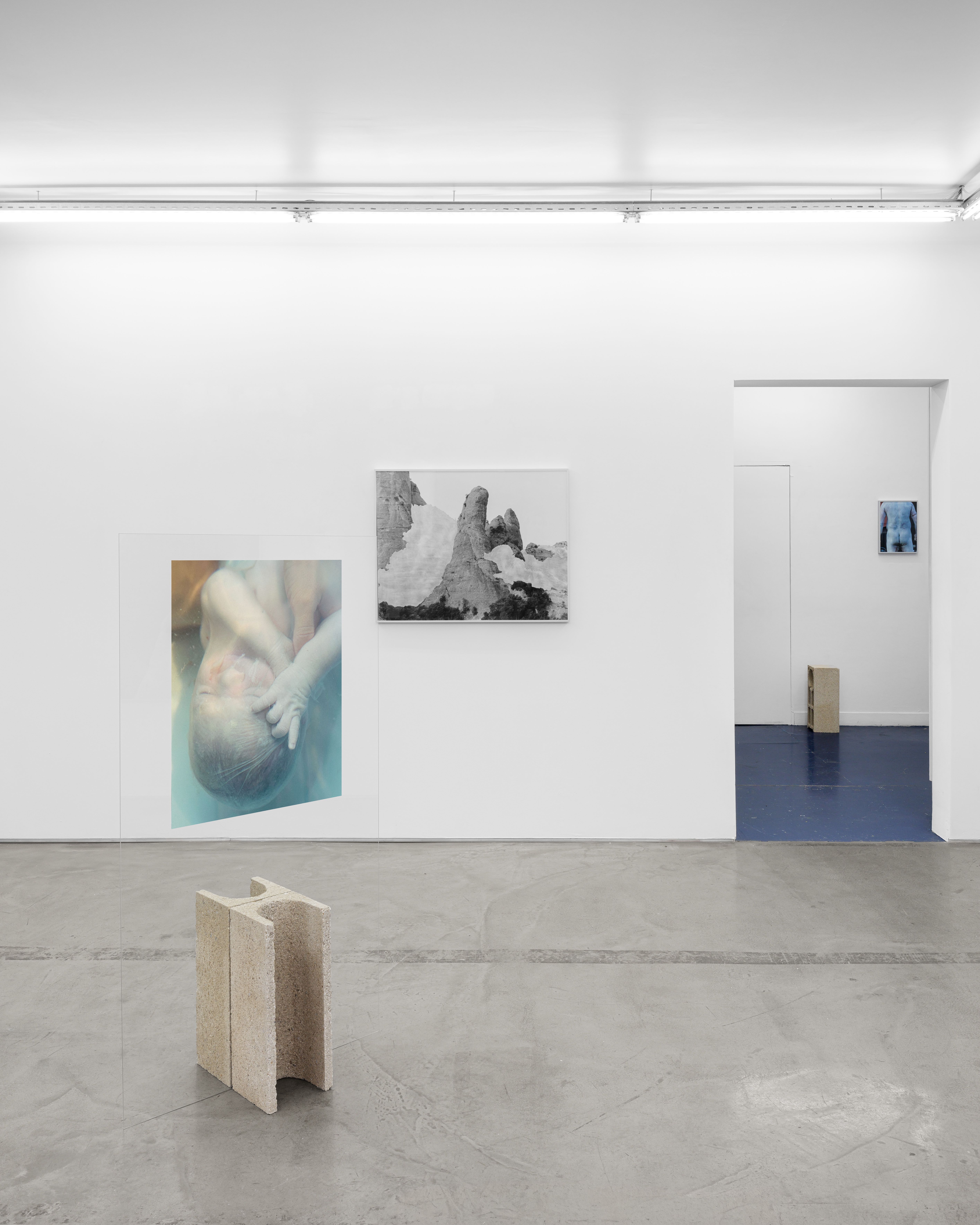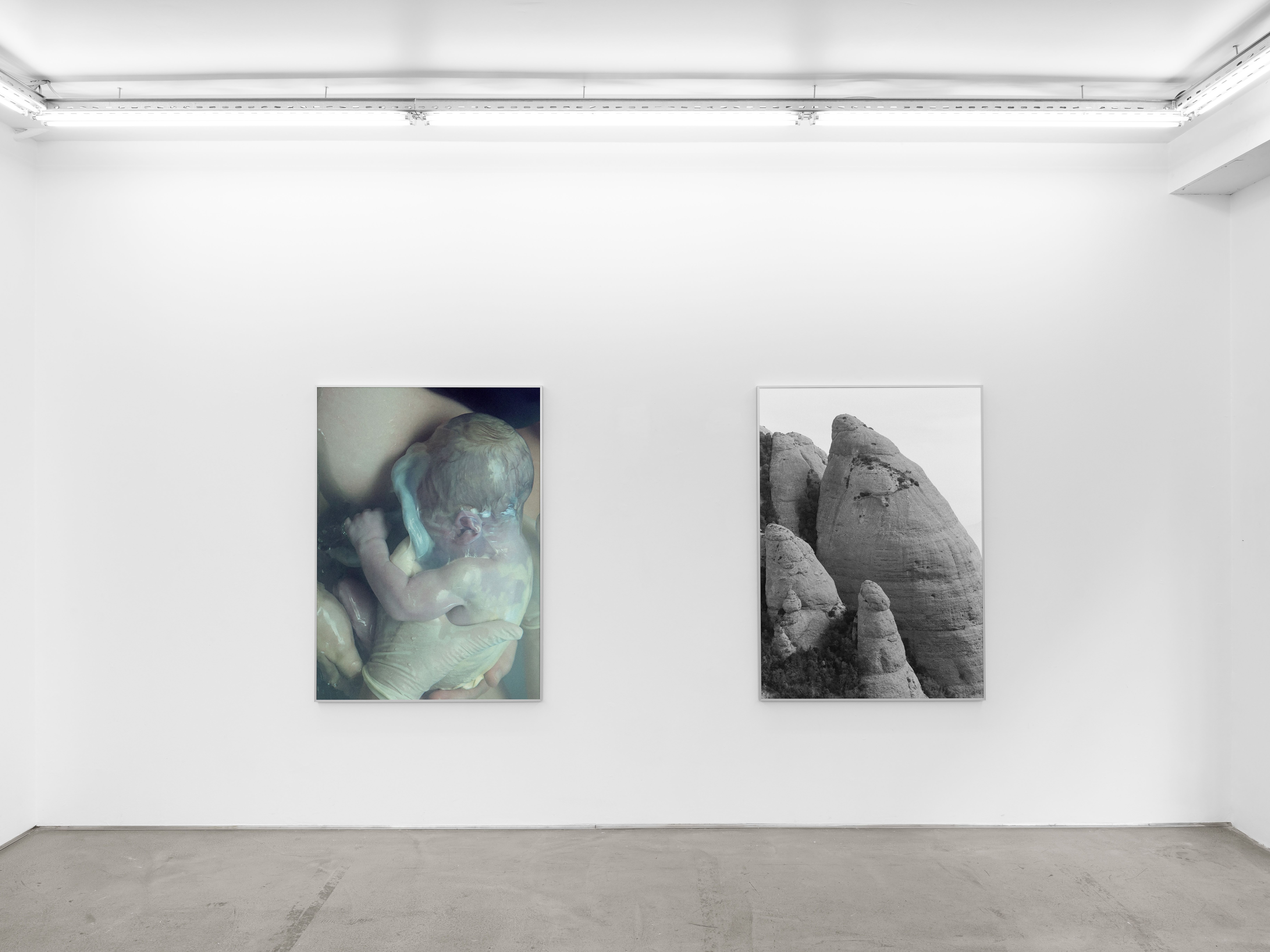
There is, first, a visit to Montserrat, where the strange, phallic formations of the mountain range rise in their “erotic, generative, almost anatomical” bearing, as Pegah Farahmand writes. They stand beside a Benedictine monastery founded there in 1025, and in this encounter two forms of the sacred meet: one proceeding from religion and ritual, the other enshrined in nature and landscape. Sexuality and spirituality, fertility and death, the human body and the geological body cohabit there, the divine lodging as much in things as in the landscape. Whence, surely, the essential ground of pilgrimage as a movement that surveys the world in order to cross its thresholds: those that separate even as they bring into contact “the sacred and the profane, the body and the landscape, birth and dissolution, the material world and whatever might exist beyond it,” as the photographer further notes. The recurring forms that gather flesh and stone, that veil or unveil themselves, figure in their own way emergence, decline and return. Pilgrimage stages this same movement of physical passage toward a threshold, there where the body wears itself out and the ordinary structures that usually mobilize bodies are temporarily effaced.
For there’s walking, and then there’s walking. Taken on its own terms, it is an inevitable physiological fact, every bit as indispensable. Taken for its causes and its purpose, though, it becomes a phenomenon that binds the whole of humanity together, beyond anything biology can account for. And so, here below, here and there, women, children, men and the old set out walking, all of them making for the same place. That, then, is pilgrimage: a matter settled neither by arrival alone nor by walking alone. The two are welded together — a journey that wears down the body, and the threshold that awaits it, the road and its end, without which it is only a stroll, or only a place. This place will often be holy — sacred in one way or another, even when that sacredness has been hollowed out of all religion. This is what these photographs bear witness to as well, when they show that this threshold, more often than not, makes itself heard in its height, in its rising.
At the far end of so much horizontal fatigue, so much ground covered, the holy site rears up — as though one could touch the divine, grace, the accomplishment that comes of suffering and self-abnegation, only once the body has been tipped from the plane of earth onto that of sky. The staircase cut into the mountainside, the temple raised into a second summit, the totem and the door crossed like a mountain pass — glass or not — that invent a verticality the earth itself did not offer: pilgrimage nearly always ends in an architecture raised upward. The two views Pegah Farahmand brought back from Montserrat tell its prehistory: peaks no architect ever raised, yet which already perform the one gesture of all sacred architecture — rising. The verticality of the stone seems to have prepared the earth to receive that of ecstasy. The sheets of palladium leaf with which the photographer partly covers these views, recalling the illuminations of medieval manuscripts designed to catch the eye, evoke in turn the vision of Hildegard of Bingen, who in her Scivias (c. 1151) described a « grande montagne couleur de fer » embodying « force et stabilité », and, in her view, impervious to any « mutabilité branlante ».
It is perhaps precisely by testing and exhausting their bodies, pushing to the very limits of their impermanence, that pilgrims go in search of eternity. In their flesh, in the exhaustion and the bliss that wait at journey’s end, they perceive what Victor Turner called a threshold state: neither here nor there, “betwixt and between,” likened by turns to death, to the maternal womb, to invisibility, to darkness*. This threshold is not only a metaphor: it once had a precise body of its own — that of the child born with a caul, still wrapped in the amniotic membrane, said in several traditions to be a medium for its power to “see” into the world of spirits. Pegah Farahmand’s images do indeed return endlessly to this same motif of the veil, the membrane, of whatever wraps without quite concealing. For the veil was never only a thing that hides: in the Qur’an, the word hijab does not mean a garment but a screen, a partition — and it is from the reverse of a hijab that God, it is said, speaks to men. Threshold, veil and membrane are thus but a single apparatus: a place of passage that is also, for whoever inhabits it, a gift of second sight. The photographer underlines it herself: transcendence comes by way of blindness rather than sight — and the image must then dissolve.
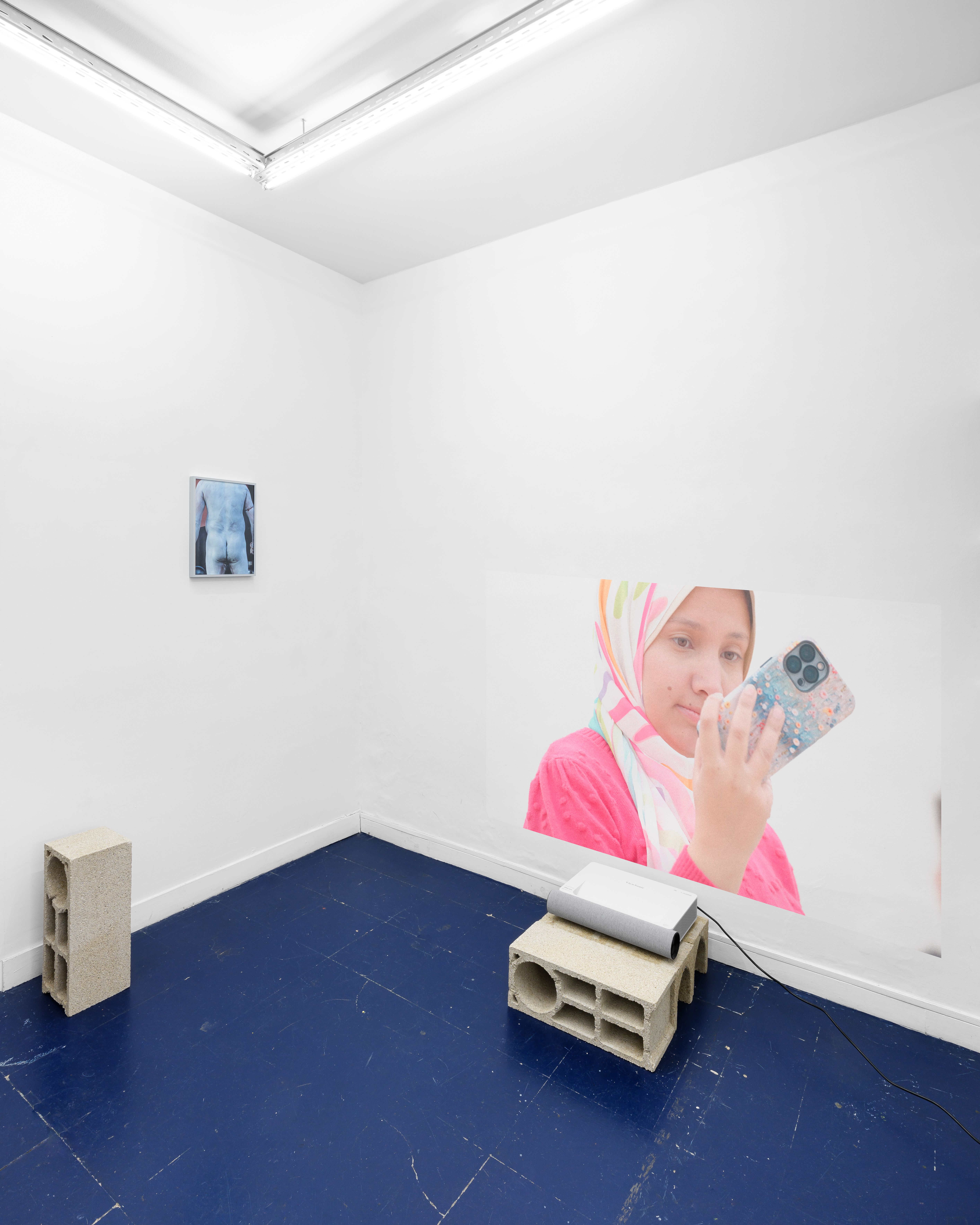
The contemporary pilgrim’s new grail is often made of this: no longer the tomb, but one’s own image standing before the tomb. Mummy Complex, the film Pegah Farahmand shot at the foot of the pyramids of Giza, bears this out. André Bazin had sensed as much already: at the root of every image, he said, lies a « complexe de la momie** », that is, the desire to save the perishable body from a conclusive disappearance. And yet it is an unfathomable grail all the same, since a mere photograph can never capture the thickness of millennia, pinned as it is to the order of the instant.
Indeed, it can never capture this Superessential that early Christian mysticism spoke of — a dazzling darkness where divinity is met only beyond all form and all light. Hildegard von Bingen would describe an analogous paradox: a “shadow of the Living Light,” and, more rarely, within it, the Living Light itself, which, she says, erases all sadness***. That threshold is experienced as a piercing of the veil between profane and sacred, life and death, high and low, visible and invisible. One reaches it as one would enter a trance: body and spirit carried off by a call that admits no argument, that offers no explanation, and that is nonetheless followed.
Guillaume Blanc-Marianne
Paris, 02.XI.26
* Victor Turner, The Ritual Process: Structure and Anti-Structure, Chicago, Aldine, 1969.
** André Bazin, « The Ontology of the Photographic Image [1945] », in Alan Trachtenberg (ed.), Classic Essays on Photography, Leete’s Island Books, New Haven (Connecticut), 1980, p. 237-243.
*** Hildegarde de Bingen, Selected Writings, trad. Mark Atherton, Londres, Penguin Classics, 2001.